
Sewing 2.0 — Intermediate Sewing
About
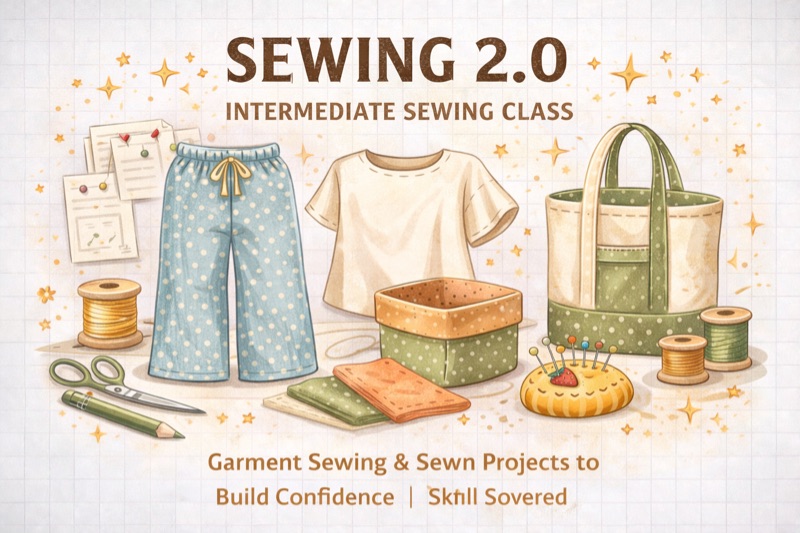
Sewing 2.0 — Intermediate Sewing 5-Day Course Sewing 2.0 is an intermediate sewing course designed for students who have completed a Basic Sewing class and are ready to build confidence through garment sewing and structured projects. Over five class sessions, students will create both wearable garments and functional sewn items while learning techniques that elevate their skills beyond the basics. This course focuses on clean construction, proper use of interfacing, pattern reading, and finishing techniques that help students sew with more independence and confidence. Projects Include: Elastic-waist pajama pants Drop shoulder blouse with facing, sleeves, and button Structured organizer basket Fully lined tote bag with pocket (completed over two sessions) Skills Covered: Reading and using printed patterns Garment construction and fit basics Elastic waistbands and hems Sewing with facings and inset sleeves Using fusible interfacing and fleece Lining projects cleanly Sewing boxed corners Reinforcement and professional finishes This class moves at an intermediate pace with guided instruction and hands-on practice. Students are encouraged to problem-solve, ask questions, and build confidence while sewing independently. Prerequisite: Completion of Basic Sewing / Sewing 1.0 or be confident in your sewing machine and basic sewing skills Course Length: 5 sessions Skill Level: Intermediate beginner Students must bring their own sewing machine and supplies, machines are available to borrow when reserving ahead of time for no charge, while supplies last and if available.
Schedule
Session 1 — Pajama Pants Project Caption: Sew a comfortable pair of elastic-waist pajama pants while learning to follow a printed pattern and construct a wearable garment. Supplies Needed: 2⅞–3 yards of fabric (based on size) 1” wide elastic (approx. 1¼ yards) Coordinating thread & empty bobbin Sewing machine & basic sewing tools
Session 2 — Drop Shoulder Blouse Project Caption: Create a relaxed-fit blouse while learning facings, sleeves, button sewing, and clean garment finishing techniques. Supplies Needed: Approx. 2 yards lightweight to medium-weight fabric ¼ yard lightweight fusible interfacing One 8 mm button Coordinating thread & empty bobbin Sewing machine & basic sewing tools
Session 3 — Organizer Basket Project Caption: Make a small, structured organizer basket that stands on its own using lining, interfacing, and boxed corners. Supplies Needed: 2 fat quarters (exterior & interior) Fusible fleece (18” × 22”) Stiff fusible interfacing (18” × 22”) Coordinating thread & empty bobbin Sewing machine & basic sewing tools
Session 4 — Lined Tote Bag (Part 1) Project Caption: Begin constructing a fully lined tote bag by cutting, interfacing, and assembling panels and an interior pocket. Supplies Needed: 1 yard outer fabric A 1 fat quarter outer fabric B (accent/pocket) 1 yard fusible fleece Stiff to midweight interfacing (30” × 19”) Button or snap for pocket Coordinating thread & empty bobbin Sewing machine & basic sewing tools
Session 5 — Lined Tote Bag (Part 2) Project Caption: Finish the tote bag by attaching handles, sewing boxed corners, assembling the lining, and completing final details. Supplies Needed: Tote bag materials from Session 4 Coordinating thread & empty bobbin Sewing machine & basic sewing tools General Supplies (Bring to Every Session): Sewing machine (in good working order) Scissors, pins or clips, seam ripper Measuring tape or ruler Fabric marking tool Matching or neutral thread Empty bobbins Limited shared tools available: irons, ironing boards, rotary cutters, cutting mats, and rulers.