
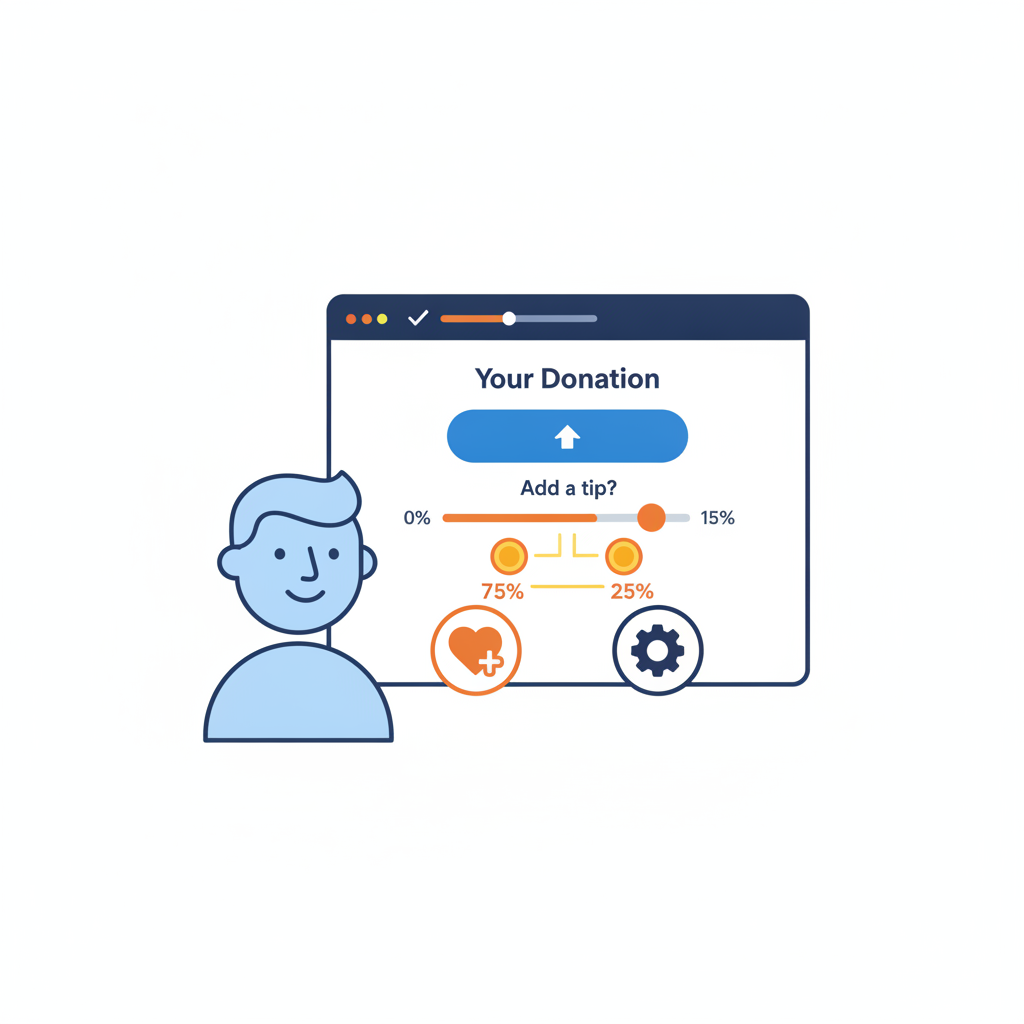
"100% free for nonprofits" is one of the most persuasive phrases in fundraising software — and one of the most misunderstood. The platform is free to your organization. It is not free to your donors. Understanding who actually pays, and how much, is the difference between a smart choice and an expensive surprise.
This is a companion to our nonprofit fundraising event software guide, zooming in on the pricing model that trips up the most operators.
How "free" platforms actually make money
Free fundraising platforms don't run on air. The common model is optional donor tips: when a supporter completes a donation or buys a ticket, they see a tip prompt with a percentage pre-filled — often around 15–17% of the gift — to help keep the platform free.[1] The tip is optional and can be set to zero, but it's a default, and roughly two out of three donors leave it on.[1]
That's a real funding model, and for some small nonprofits it works out fine. But "free to the nonprofit" quietly becomes "paid by the donor," and most donors don't realize it. As one nonprofit reviewer put it, a supporter giving $100 may end up paying $115 without noticing that the extra went to a tech company rather than the cause.[2]
Run the math on your average gift
The honest comparison is total cost per dollar raised. Here's how a flat capped fee compares to a default donor tip. Addmi is listed first because a flat, nonprofit-paid rate is the easiest to predict.
| Model | Who pays | Cost on a $200 gift |
|---|---|---|
| Addmi (flat 3%, capped at $39) | The nonprofit | $6 |
| Tip-funded "free" platform | The donor (if tip left on) | ~$30–$34 at a 15–17% default[1] |
On a small gift, a tip might be a dollar or two — genuinely cheap. On a $200 ticket or a $500 major gift, a default tip can dwarf a flat capped fee. The point isn't that free is bad; it's that free isn't automatically cheapest. Model your real average gift and ticket price through both before deciding.
What you might give up beyond price
Cost is only part of it. Two things are worth checking on any platform, free or paid:
- Donor data ownership. Confirm you own and can export 100% of your donor records. Vendor lock-in and donor-data silos are a recurring concern with fundraising tools.[3]
- On-site sales. Many platforms stop at the online donation and don't run the gala floor — the bar, merch, and auction checkout covered in cashless POS for nonprofit galas.
The transparent alternative
There's a middle path between "free but donor-funded" and "expensive commercial ticketing": a flat fee paid by the nonprofit, capped so it never runs away on big tickets. Addmi charges a flat 3% per ticket capped at $39, has a free plan with no monthly fee, and adds no tip prompt to your donors — so your supporters give what they meant to give. You also keep 100% of your donor data and get on-site POS in the same dashboard.
If you're weighing the big commercial brand instead, our Eventbrite alternatives for nonprofits comparison runs the same numbers across platforms. Whatever you choose, choose with the real math — not the headline.
Related guides
- Nonprofit Fundraising Event Software: The 2026 Guide
- Eventbrite Alternatives for Nonprofits
- Cashless POS for Nonprofit Galas
- Event Ticketing · Pricing
Sources
[1] Zeffy — how tip-funded fundraising platforms work (default ~15–17% donor tip; ~2 of 3 donors tip), 2026 [2] Linda Handley / Donorbox — critiques of the donor-tip funding model (2026) [3] LiveImpact, Momentive, Soapbox Engage — nonprofit data-ownership and vendor lock-in concerns (2026)