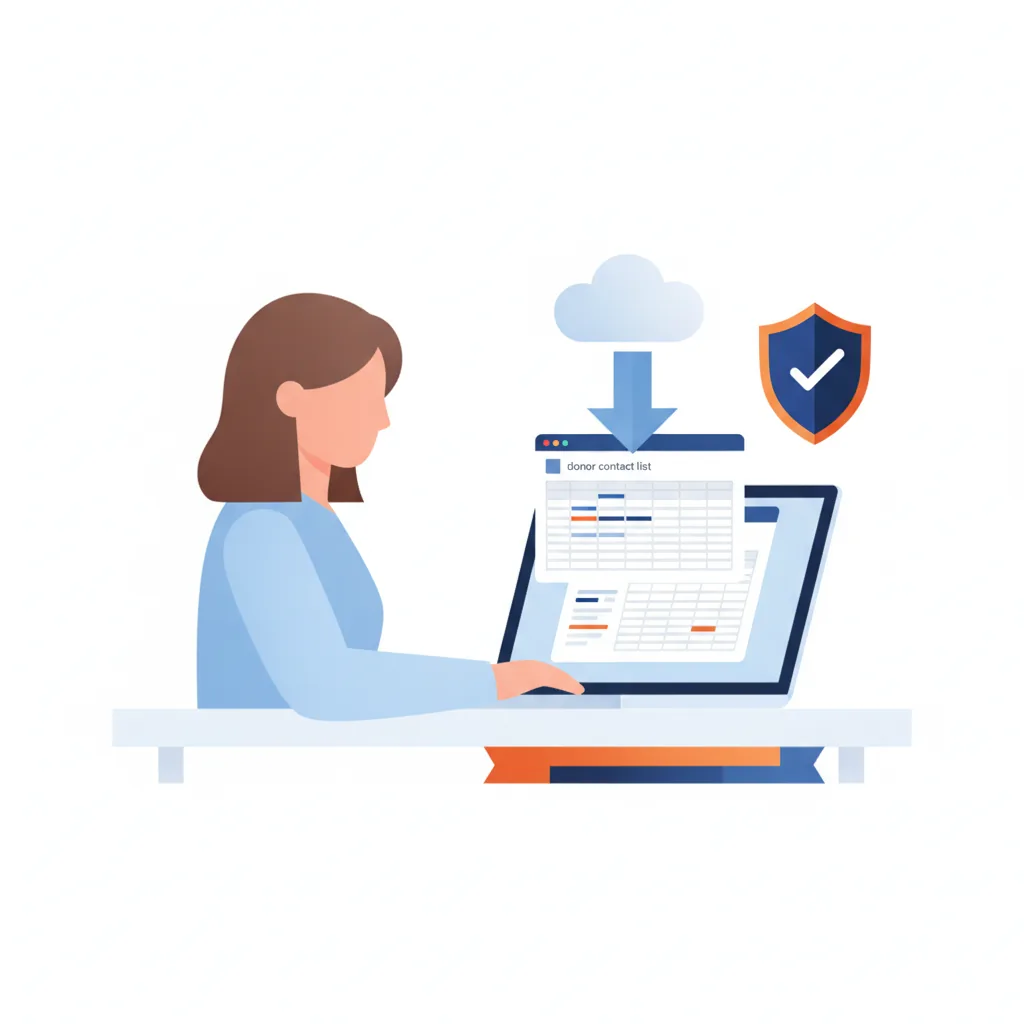
Here is the test that cuts through every sales demo: if your fundraising platform disappeared tomorrow, could you export your full donor list — every record, every custom field — in five minutes? If the answer is "I think so" or "I'd have to ask," you do not really own your data. For a nonprofit, the donor list is the whole asset, and who controls it is the most important question you are probably not asking.
This is a companion to our nonprofit fundraising event software guide — the part about the asset that outlives any single event.
"We own our data" is not the same as "we can leave with it"
Most platforms will say you own your data. What matters is whether you can act on that — export full records, not a summary, on demand. In 2026, nonprofit leaders are increasingly cautious about data privacy, vendor lock-in, rising subscription costs, and fragile integrations, precisely because the gap between "you own it" and "you can export it" is where organizations get stuck.[1]
With Addmi you own 100% of your donor and attendee data with full CSV and Excel export, you keep the custom fields you collect at registration, and the checkout never markets competing events to your supporters. That is the difference between renting access to your donors and owning the relationship.
The per-contact pricing trap
Watch how the platform is priced, because the pricing model is a lock-in mechanism. Many nonprofit tools charge per constituent record, so the bill rises as your donor list grows — your success quietly becomes a cost, and leaving gets more expensive the bigger you get.[2] The advertised price is rarely the full picture once per-contact overages, add-on modules, and premium support are stacked on.[2]
Addmi runs on a free plan with no monthly fee, month-to-month with no contracts, and a flat 3% per ticket capped at $39 on event sales — so growing your donor base does not grow your software bill, and you are never penalized for the list getting bigger.
The export checklist
Before you sign anything, pressure-test each platform on the questions that decide whether the data is really yours:
- Full export — can you download complete donor and attendee records (not a summary) to CSV or Excel, on demand, yourself?
- Custom fields — do the fields you collect at registration belong to you and come out in the export?
- No competing-event marketing — does the checkout ever advertise other organizations' events to your donors?
- Pricing model — is it flat, or per-contact that scales with your list?
- Contract terms — month-to-month, or a locked annual deal that makes leaving painful?
Addmi was built to pass all five. The same export discipline is what makes the rest of the event work — a silent auction tool or a ticketing platform is only as useful as the donor records it hands back, which is why we flag it in both nonprofit silent auction software and our Eventbrite alternatives for nonprofits comparison.
Data ownership is what powers the next ask
This is not paperwork — it is fundraising. The donor data from one event is what makes the next campaign work: who attended, who bid, who gave, and how to thank them. Own that data and every event compounds; rent it and you start over each time you switch tools. Choose the platform that hands you the full list whenever you ask, and your supporter relationships stay yours for good. For the complete buying decision, the fundraising event software guide ties fees, data, and on-site sales together.
Related guides
- Nonprofit Fundraising Event Software: The 2026 Guide
- Eventbrite Alternatives for Nonprofits
- Donor Retention After a Fundraising Event
- Memberships · Pricing
Sources
[1] DonorDock, NonProfit PRO, LiveImpact — 2026 nonprofit buyer concerns: data privacy, vendor lock-in, export, and fragile integrations [2] Bloomerang, Neon One — per-contact / per-constituent pricing models and total-cost-of-ownership for nonprofit platforms (2026)