
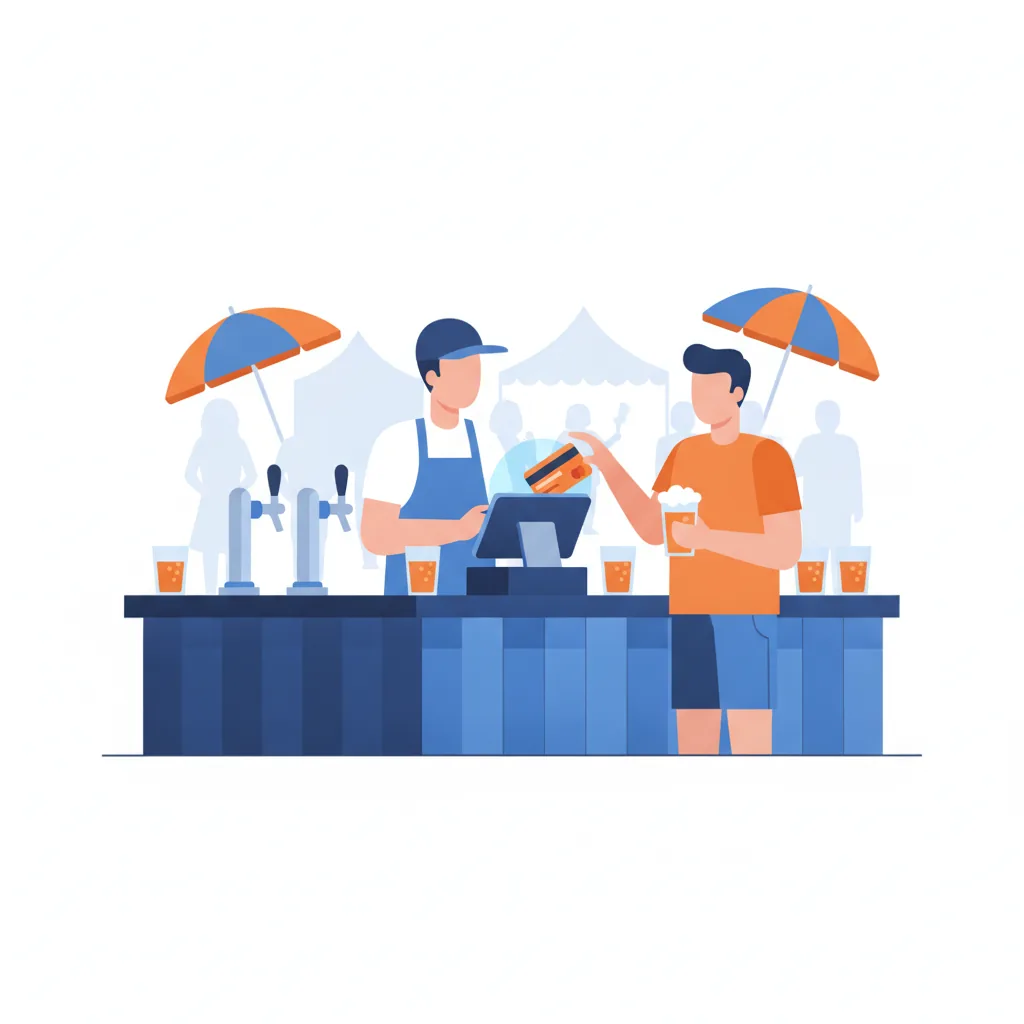
At most festivals, the bar is the best margin on the site. Beer carries a gross profit margin around 78%, and a well-run beer garden nets somewhere in the 10–20% range once labor and pour cost are covered.[1] It is also, reliably, where the longest lines form. Every minute a thirsty attendee spends waiting is a drink you didn't sell and a memory that sours. A festival bar POS is the tool that decides whether that high-margin revenue actually reaches the till or gets stuck in a queue.
This guide is a companion to our pillar, festival management software: the 2026 organizer guide, focused on the bar and beer garden specifically: speed at the tap, age verification, the drink-ticket-versus-cashless question, and why alcohol sales need to land in the same report as everything else.
Speed at the tap is the whole job
Bar lines are one of the three classic festival bottlenecks, alongside gates and shuttles. The fix is a POS interface built for a field environment, not a restaurant: a simplified, tap-and-go screen where a bartender rings a beer in two taps and takes payment in one.[2] The slower the interface, the shorter your effective selling window during peak sets.
Addmi's answer is unlimited POS terminals with no per-device fee, so you can put a tablet at every well and every satellite bar without your hardware bill scaling with your bar count. More stations means more parallel lines, and more parallel lines is the single biggest lever on bar throughput. Adding a sixth tap station costs you a spare tablet, not a device license. That's the same unlimited-terminal model behind cashless festival POS and RFID payments across the rest of the site.
Drink tickets vs. cashless: which is faster
For decades the festival bar ran on paper drink tickets: attendees bought tokens at a booth, then traded them for drinks. It works, but it staffs a whole second line (the token booth), leaves you reconciling unused tickets afterward, and adds a step for the guest. Modern festivals increasingly favor cashless card and tap-to-pay at the bar itself, which removes the token booth entirely and clears a line quickly.[2]
The honest answer is that you may want both. Cashless is faster for the general crowd; prepaid drink packages still make sense for VIP wristbands or all-inclusive areas. Addmi supports tap-to-pay on every terminal and can run prepaid drink packages where you want them, so you're not forced to choose. Either way, keep water and non-alcoholic options flowing at the same bar — outdoor heat plus alcohol makes hydration a safety issue, not a nicety.[2]
Age verification and alcohol compliance, built in
Selling alcohol adds obligations a merch tent doesn't have: an age-verification step at the point of sale, correct state and local tax settings, proper tip handling, and PCI-compliant card processing.[3] Bolting those on after the fact is how festivals end up with a compliance headache and a tax figure nobody can reconstruct.
Addmi builds the age-check prompt and tax handling into the sale itself, so the bartender is guided through it and the numbers are captured as they ring. Because the bar runs on the same point of sale as the food stalls and merch, your alcohol revenue and the tax on it are already itemized when the event closes — no separate beer-garden spreadsheet to reconcile against the rest of the weekend.
One number for the whole weekend
The reason to run the bar on the same platform as the gate and the vendors isn't tidiness — it's the close-out. When bar sales, gate scans, and vendor sales all report into one dashboard, you get a single set of numbers you own, with alcohol broken out for tax and the bar's contribution to the day visible at a glance. Compare that to exporting three systems and stapling them together at 1 a.m.
That unified view starts at check-in — see festival check-in software for the gate side — and runs through every sale on the site. Addmi also lets you keep the customer data those sales generate, so the crowd that came this year is yours to invite back.
If a fast, compliant, high-margin bar is the goal, start with on-site point of sale, see how ticketing and POS connect in event ticketing, check pricing, or return to the festival management guide.
Related guides
- Festival Management Software: The 2026 Organizer Guide
- Cashless Festival POS & RFID Payments
- Festival Check-In Software: Gate Entry That Keeps Lines Moving
- Point of Sale · Event Ticketing · Pricing
Sources
[1] Unleashed, 7shifts — beer sales carry a gross profit margin around 78%; a well-managed beer garden nets roughly 10–20%; typical bar pour cost runs ~18–24% of revenue [2] Ticket Fairy, Peak Beverage — festival beverage operations: simplified tap-and-go bar interfaces for field environments, drink tokens/packages and cashless options, bars as a primary queue bottleneck, and the need to provide water and non-alcoholic drinks in alcohol-service areas [3] Poszeo, Ticket Fairy — 2026 bar POS guidance: age-verification workflows, correct state tax settings, proper tip reporting, and PCI-compliant payment processing for alcohol sales