
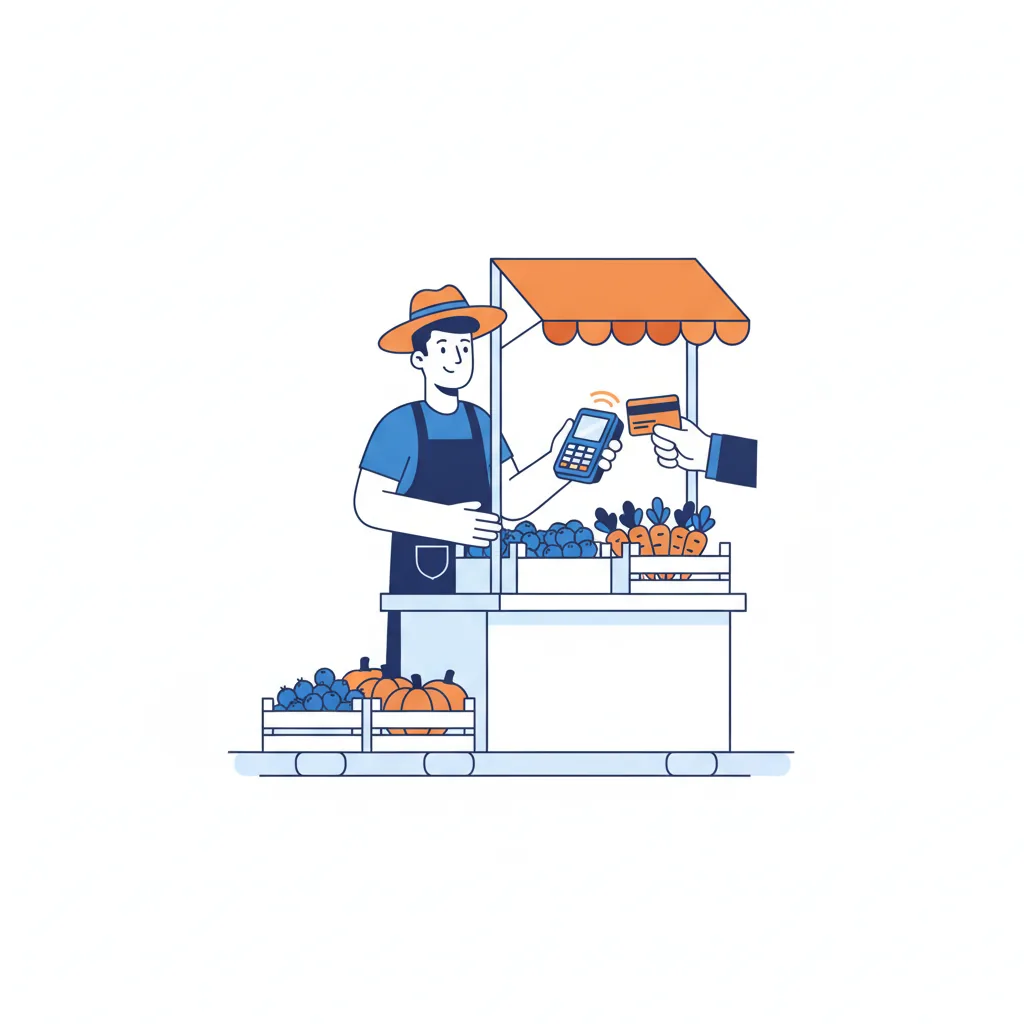
There are about 8,863 farmers markets listed by the USDA — up from 1,755 in 1994 — and the US farmers market segment was worth roughly $1.4 billion in 2024, growing 7.6% that year.[3] It is a thriving, cash-light, deeply local business. And it has a POS problem all its own: vendors sell outdoors, where power and signal are unreliable, on small margins, with shoppers who increasingly expect to tap a card or pay with SNAP rather than dig for cash.
This guide covers how farmers market vendors and market managers should choose a POS in 2026. It shares the same DNA as the food truck POS operator guide — mobile, fast, offline-aware — but adds the market-specific pieces: SNAP/EBT, booth fees, and equipping many small vendors at once.
What a farmers market vendor actually needs
A produce grower or a jam maker at a Saturday market is not running a restaurant. The POS has to be almost invisible: cheap, pocket-sized, and dependable in a field. The essentials are short:
- Mobile hardware — a phone or small handheld with an affordable card reader, not a countertop terminal.
- Every payment type — cash, chip, tap, and mobile wallets, because a shopper who cannot tap often walks.[4]
- Offline-aware card acceptance — outdoor signal is the number-one variable, and a POS that only takes cash offline loses sales.
- Low, predictable fees — on a $6 jar of honey, a rate that creeps upward on small tickets quietly matters.
- Data you own — a market can build a loyal following if it keeps its own customer list.
Addmi covers these with a mobile-first POS, a low-cost reader, a flat 19¢ per transaction, and full data ownership on a free plan — so a vendor can start selling cards this weekend without a contract.
Accepting cards outdoors: the offline reality
The single biggest technical risk at a market is connectivity. Booths sit in fields, parking lots, and town squares where cell signal is patchy, and most POS “offline modes” are a degraded fallback, not full operation.[5] Many systems only work offline for cash and need a live connection for any card unless a failover router is present.[5] Square processes offline cards but caps it at 24 hours and makes the vendor absorb the loss on a later decline; Toast’s local-sync mode drops loyalty and gift cards.[5]
For a market vendor, the practical guidance is the same as for a food truck: read the exact offline behavior before you rely on it, keep cash as a backup, and favor a POS that handles brief signal drops gracefully. The market-manager version of this problem — many booths, one unreliable field — is why the whole market benefits from a single, well-understood platform rather than forty vendors each guessing.
SNAP/EBT: reaching shoppers who pay with benefits
Accepting SNAP is both a mission and a market-expansion move. Thousands of US farmers markets accept SNAP via EBT, many pairing it with matching programs that double shoppers’ dollars, and the 2018 Agricultural Act authorized SNAP mobile payments on phones, tablets, and smartwatches as an alternative to physical EBT cards.[1]
The recurring barrier is cost: EBT equipment and processing fees keep some farmers and markets from enrolling.[2] That is why funding models matter — markets commonly cover SNAP/EBT through flat vendor fees or a percentage of token sales, plus donations and sponsorships, and several programs offer free mobile SNAP apps so farmers can accept benefits on their own devices.[2] The takeaway for a manager: budget for the SNAP program as part of vendor fees, and choose tools that keep the per-vendor cost near zero.
For market managers: equipping every booth without a per-device tax
A market manager’s POS question is different from a single vendor’s. It is: how do I let 40 booths take cards, keep the fee structure fair, and not drown in reconciliation? The answer hinges on two things — per-device cost and payout clarity.
Per-device fees are the quiet killer. A platform at roughly $69 per month per terminal makes equipping a whole market absurdly expensive.[6] Addmi includes unlimited terminals at no per-device fee, so a manager can outfit every booth on one flat plan — the same principle that keeps a multi-stall food hall POS affordable. Markets fund themselves through booth fees (flat weekly, monthly, or seasonal, sometimes plus a percentage), and a POS that reports each vendor’s sales cleanly makes those fees and any percentage splits easy to settle.[2]
Keeping your customers — and your money — yours
Markets build something rare: a weekly, face-to-face relationship with local shoppers. That is worth protecting. The two ways it leaks away are the same everywhere in this business — giving up your data to a third-party app, and giving up control of your funds to a shared merchant account.
Square’s shared sub-merchant model means one seller’s issue can trigger holds that catch others, with documented cases running into tens of thousands of dollars and slow support to resolve them.[6] For a vendor whose whole week’s income clears on a Saturday, a fund hold is a genuine emergency. Addmi keeps your customer and sales data fully exportable and your money your own, so a market following becomes an email list and repeat business — not someone else’s asset. Start on the free plan, explore point of sale, or step back to the food truck POS operator guide.
Related guides
- Food Truck POS Systems: The 2026 Operator Guide
- Food Hall POS & Vendor Management: The 2026 Guide
- How Much Does a Food Truck POS System Cost? (2026)
- Point of Sale · Online Ordering · Pricing
Sources
[1] NCOA, UMN Extension — thousands of US farmers markets accept SNAP via EBT, many with matching programs; the 2018 Agricultural Act authorized SNAP mobile payments on phones/tablets/smartwatches as an alternative to physical EBT cards [2] Farmers Market Coalition, USDA FNS — markets fund SNAP/EBT via flat weekly/monthly/seasonal vendor fees or a % of token sales, plus donations and sponsorships; cost of EBT equipment and processing is a barrier to enrollment; free mobile SNAP apps available to farmers/markets [3] USDA ERS, IBISWorld — ~8,863 USDA-listed US farmers markets (up from 1,755 in 1994); US farmers market segment ~$1.4B in 2024, up 7.6% that year [4] KimEcopak — 2026 shoppers expect cash, cards, contactless, Apple Pay, Google Pay, and QR ordering; a POS handling only one or two types costs sales [5] POSaic, Quantic — most POS offline modes are a limited/degraded fallback; many work offline for cash only; Square caps offline cards at 24 hours with merchant absorbing later declines; Toast local-sync drops loyalty/gift cards [6] POS USA, AGMS — Toast ~$69/mo per terminal; Square shared sub-merchant model with documented fund holds into the tens of thousands and slow support