
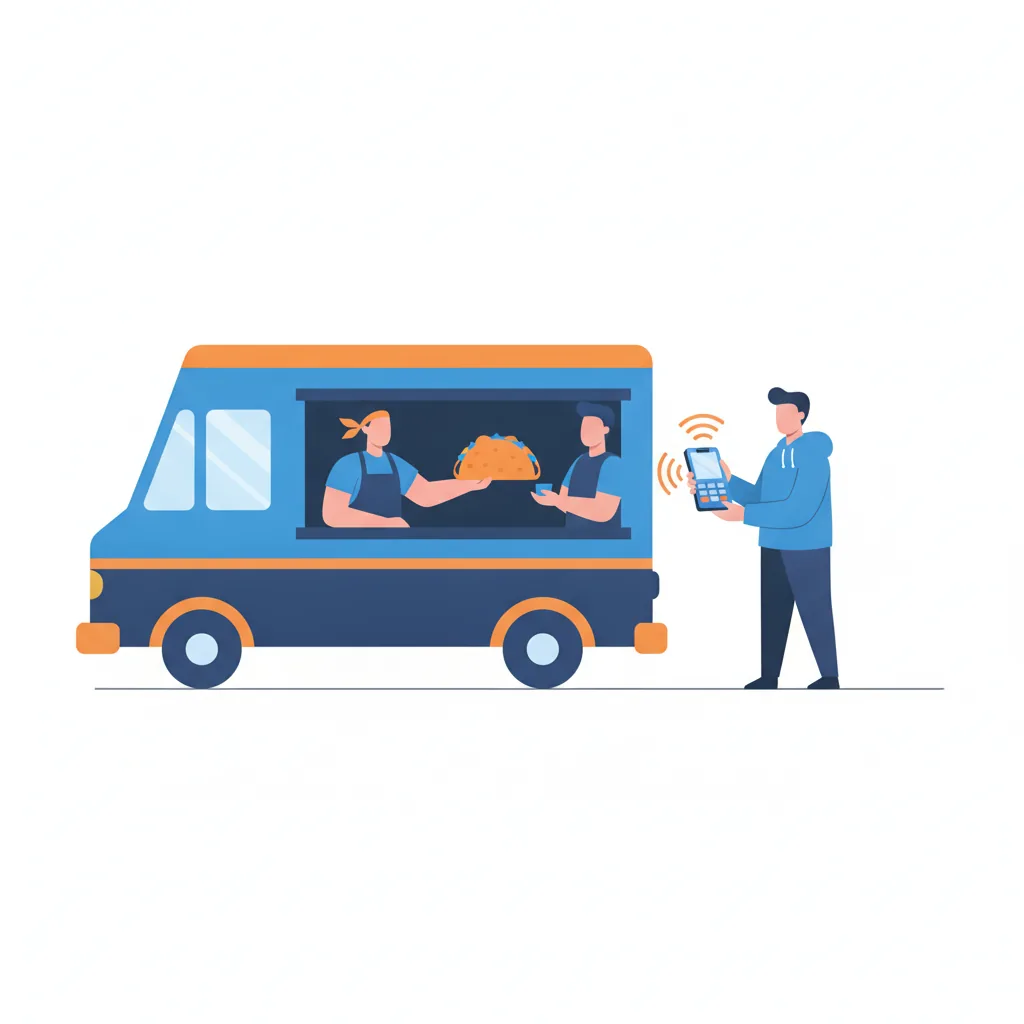
There were 92,257 food trucks operating in the United States in 2025 — up 16.9% in a single year, growth that leaves the broader restaurant industry far behind.[1] But the money in this business is brutally concentrated: about 63.6% of operators say their day is made or lost in a roughly three-hour window, and that window drives 60% to 70% of daily revenue.[2] When two-thirds of your income arrives in 180 minutes, every second the line stalls at the window is money that drives away.
A food truck POS system is not a smaller version of a restaurant POS. It has to be fast enough to clear a rush, portable enough to live in a cramped service window, and reliable enough to keep selling when the cell signal drops at a park or a festival. This guide walks through how to evaluate a food truck POS in 2026 without getting caught by the fees, the contracts, and the offline fine print that trip up mobile vendors.
What a food truck POS system actually has to do in 2026
The core job is simple to say and hard to do well: take an order, take a payment, and get the customer moving — over and over, fast, in a hot metal box. The trucks that keep their line short expect one system to cover all of it:
- Speed at the window — a two-tap order-to-payment flow, not a five-screen maze.
- Every payment type — cash, chip, tap, Apple Pay, Google Pay, and QR ordering, because customers in 2026 expect all of them.[6]
- Offline-friendly card acceptance — sales continue when the signal at the curb does not.
- Portable, affordable hardware — a handheld or a phone-plus-reader, not a countertop stack.
- Recipe-level inventory — selling a taco should auto-deduct the tortilla and the protein, with low-stock alerts before you sell out.[6]
- Reporting and customer data you own — so a busy Saturday builds a mailing list, not just a cash pile.
The U.S. food truck services market was about $2.01 billion in 2025 and is projected to reach $3.56 billion by 2033, and the software chasing it has multiplied into dozens of overlapping tools.[7] The trap is buying a POS built for a sit-down restaurant and paying for tables, coursing, and floor plans you will never use. Addmi’s POS is mobile-first — it runs the window, online ordering, and even ticketed pop-up events from one dashboard, without the sit-down overhead.
Speed and offline reliability: the two things that quietly cost you sales
If your revenue is concentrated in a three-hour rush, the two failure modes that hurt most are a slow checkout and a dead connection.[2] Speed is about the flow: how many taps from order to paid, and whether tap-to-pay is native. Offline is about survival, and it is where the marketing and the reality diverge.
Most POS “offline modes” are a limited, degraded fallback designed to bridge a short gap, not to run your whole shift.[3] The specifics are worth knowing before you park somewhere with no bars:
- Square processes offline card payments on all hardware but caps them at 24 hours from the first offline transaction, disables gift cards and manual entry, and makes you — the merchant — eat the loss if a card later declines.[3]
- Toast auto-activates a local-sync mode after about 40 seconds offline, but loyalty, gift cards, and text-to-pay stop working.[3]
- Many systems only work offline for cash, and require connectivity for any card unless a failover router is in place — a real problem for a card-heavy truck.[3]
The practical move is to pick a POS whose offline behavior you have actually read, keep contactless and cash as backups, and treat any “works offline” claim as a question, not a promise. For a deeper look at multi-vendor and outdoor settings where connectivity is worst, see our guides on food hall POS and vendor management and farmers market POS.
The real cost: processing, per-terminal fees, and contracts
Software is the number you see in the ad; processing is the number that actually shapes your year. And on a food truck’s small average ticket, the processing rate behaves differently than the headline suggests.
Square advertises 2.6% + 10¢, which sounds cheap — but that flat 10¢ is a bigger bite on a small order, pushing the effective rate to about 3.41% on a $12.40 average ticket.[4] Toast starts around $69 per month per terminal and locks you into its own payments at 2.99% + 15¢; a truck running $40,000 a month pays roughly $1,211 in processing alone.[4] And the contract is its own cost: Toast commonly runs two-to-three-year agreements with early-termination fees, and its proprietary hardware — $5,000 to $15,000 worth of terminals and handhelds — becomes a write-off the day you switch.[5]
Addmi’s answer is a flat 19¢ per transaction passed to the customer, no per-terminal fee, unlimited terminals, and month-to-month billing with a free plan. A flat few-cents fee — with no percentage on top — stays trivial whether the ticket is a $4 taco or a big catering order, where a percentage rate keeps climbing; the no-per-terminal rule matters the day you add a second window for a two-person rush. For the full line-by-line comparison across Addmi, Square, Toast, and Clover, see the food truck POS cost breakdown.
When one truck becomes many vendors: food halls and markets
Growth in this business often means going from one window to many. A food hall puts a dozen concepts under one roof; a farmers market puts fifty vendors on one field. The POS problem changes from “ring a sale fast” to “ring a sale fast and settle up fairly with everyone at the end of the night.”
That is a different capability. A food hall needs to route each vendor’s orders to their own kitchen and then split revenue — rent, commission, shared-staff tips, taxes — automatically, without a spreadsheet.[8] A farmers market needs mobile card readers every vendor can afford, plus the ability to accept SNAP/EBT, which thousands of markets now do.[9] The common thread with a single truck is the same: unlimited terminals at no per-device fee, so scaling from one seller to many does not multiply your software bill. We cover each setting in depth in food hall POS and vendor management and farmers market POS.
Owning your customers and going commission-free
The fastest way to smooth out a business that lives on a three-hour window is to sell when the window is closed — pre-orders, catering, and repeat regulars ordering ahead. That only works if you own the customer relationship, and two common choices quietly take it away.
Third-party delivery and ordering apps charge 15% to 30% per order, and some reach 30% to 40% once fees stack up — on a food truck’s margins, that can erase the profit on the order entirely.[6] Direct, commission-free ordering costs 0% commission plus roughly 3% all-in for card processing, and any operator doing more than about $5,000 a month online comes out ahead going direct.[6] The other quiet cost is data: apps keep the customer’s name and history, and Square’s shared merchant model means your funds can be caught up in other merchants’ compliance issues — including documented holds that ran to tens of thousands of dollars.[5]
Addmi gives you free white-label online ordering under your own brand and full data ownership, so repeat orders stop paying a marketplace tax and every customer lands in a list you keep. Explore online ordering and point of sale to see how the window and the pre-order channel run from one place.
How to choose: a short checklist
Before you buy, get honest answers to six questions:
- Speed at the window — how many taps from order to paid, and is tap-to-pay native?
- Offline behavior — exactly what still works with no signal, and who eats a later decline?
- All-in cost — processing plus per-terminal fees on your real average ticket, not the headline rate.
- Contract and hardware — month-to-month and portable, or a multi-year lock on proprietary gear?
- Room to grow — can you add a second terminal, a food-hall stall, or a market booth without a bigger bill?
- Data ownership — can you export your full customer and sales list any time?
Score every option on all six and the “free” POS with the small-ticket rate creep, or the “cheap” one with the three-year contract, usually stops looking cheap. Addmi was built to answer all six the way a mobile operator would want: fast, offline-friendly, a flat 19¢ per transaction, unlimited terminals, month-to-month, and your data stays yours. Start on the free plan, see the food truck POS setup, or dig into the full cost breakdown.
Related guides
- How Much Does a Food Truck POS System Cost? (2026)
- Food Hall POS & Vendor Management: The 2026 Guide
- Farmers Market POS: The 2026 Vendor & Manager Guide
- Best Food Truck POS System 2026: Square vs Toast vs Clover vs Addmi
- Food Truck Offline POS: Taking Payments With No Wi-Fi (2026)
- Commission-Free Online Ordering for Food Trucks (2026)
- Food Truck POS · Point of Sale · Online Ordering · Pricing
Sources
[1] IBISWorld — 92,257 US food trucks in 2025, up 16.9% year over year; ~23.8% CAGR of business count 2020–2025 [2] OneHubPOS — ~63.6% of food truck operators say daily success hinges on a ~3-hour (5–8 PM) window that drives 60–70% of daily revenue [3] POSaic, Quantic, Toast documentation — Square offline capped at 24 hours with merchant absorbing later declines; Toast local-sync activates ~40 seconds offline with loyalty/gift cards/text-to-pay disabled; many POS offer offline for cash only [4] POS USA — Square 2.6% + 10¢ (effective ~3.41% on a $12.40 average ticket); Toast from $69/mo per terminal at 2.99% + 15¢, ~$1,211/mo processing on $40k/mo volume [5] Merchant Insiders, Startup Owl, AGMS, Merchant Maverick — Toast 2–3 year contracts with early-termination fees and $5k–$15k proprietary hardware lock-in; Square shared sub-merchant model with documented fund holds [6] ChowNow, Rezku, Fleksa — third-party delivery/ordering 15–30% (up to 30–40% with fees) vs direct commission-free at ~3% all-in; break-even for going direct around $5k/month online [7] Grand View Research — US food truck services market ~$2.01B in 2025, projected ~$3.56B by 2033 (7.5% CAGR) [8] GoTab — food hall POS routes each vendor under one QR to their own KDS and auto-allocates revenue (rent, commission, CAM, tips, taxes) per vendor [9] NCOA, Farmers Market Coalition — thousands of US farmers markets accept SNAP via EBT, many with matching programs