
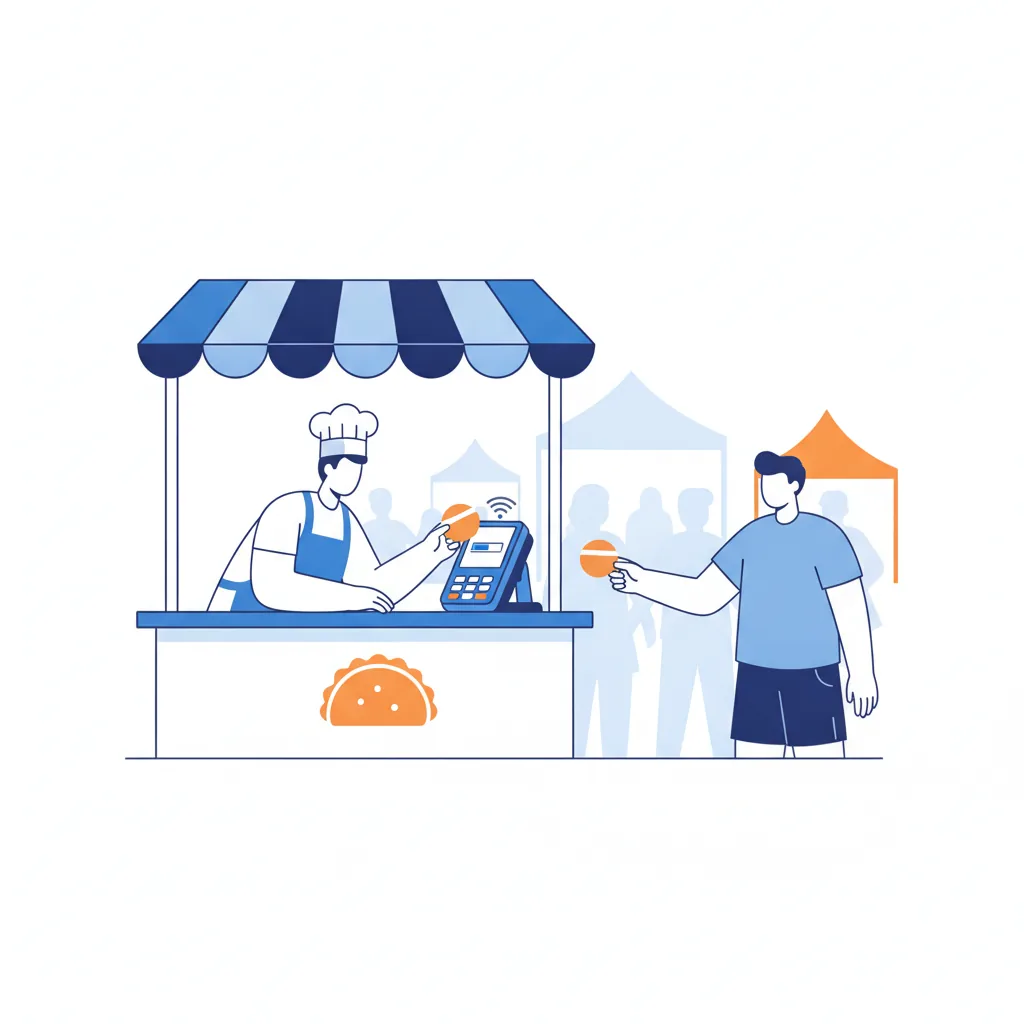
It is 12:30 on a Saturday, the line is twenty deep, and the little bars on your phone drop to nothing. At a park or a festival, that is not a rare event — it is the normal condition of the best-earning spots. What your POS does in that moment decides whether the next hour is your biggest of the day or a pile of "sorry, cash only" apologies.
This guide covers how food truck offline POS actually works in 2026, where the popular systems trip up, and how to keep cards flowing when the network is gone. It is a companion to the food truck POS systems operator guide — start there for the full buyer's framework.
What actually processes offline (and what doesn't)
Offline mode is now a baseline requirement, not a premium feature[1]. But "offline" does not mean everything keeps working. Here is the real breakdown:
- Cash — fully offline, always. No connection needed.
- Card (tap/dip/swipe) — captured locally using offline card capture, then processed when connectivity returns. The sale completes at the window; the charge runs later.
- Digital wallets and QR-code payments — generally require a live connection, so these often fall back to cash or card during an outage[1].
The mechanism is the same across good systems: the POS stores the order and payment data locally and automatically syncs to the cloud once you are back online, so no data is lost[1]. The differences are all in the limits.
The fine print that costs trucks money
Two traps catch operators who assume "offline mode" means "no consequences."
Time and amount caps. Square holds offline card transactions for up to 72 hours and defaults the per-transaction limit to $100 when offline mode is on. Any offline payment you do not reconnect within that window cannot be retrieved or reprocessed — it is simply gone[2]. During a Square outage, owners reported thousands of dollars in lost revenue[2].
Feature drop-off. Toast's local mode keeps basic ordering alive but disables loyalty, gift cards, and text-to-pay while offline[3], and many cheaper systems go cash-only the moment the signal dies. Given that only 10–20% of food truck customers still carry cash — while 55–65% pay by card or contactless[4] — a cash-only fallback means most of your rush walks away.
Why "cash only" is not a plan
It is tempting to shrug and say you will just take cash if the network drops. The math says otherwise. At a busy lunch spot a truck can serve 80–120 customers in a two-hour window[5]. If four out of five of those customers expect to pay by card and your POS can only take cash offline, an hour-long dead zone is not a minor inconvenience — it is the better part of a day's best sales lost, plus the customers who leave the line entirely.
A truck that keeps capturing cards offline — and syncs them automatically when the signal returns — turns the same dead zone into a normal hour. That resilience is the whole point of a mobile-first POS.
How to keep selling through a dead zone
- Turn offline mode on before you park, not after the signal drops — some systems only queue payments if offline mode was already enabled.
- Keep a sensible per-transaction cap so a rare later decline is a small loss, not a big one.
- Carry a failover data path — a phone hotspot or a cellular router — so card capture and sync have the best chance to run.
- Reconnect and sync often so captured payments clear well inside any hold window.
- Choose a POS built for it. Addmi keeps taking payments when the network drops, stores orders locally, and syncs automatically when you are back online — with no monthly fee, no per-terminal fee, unlimited terminals at a flat 19¢ per in-person transaction, and full ownership of your customer data. No proprietary hardware to buy into.
Offline reliability and a fair fee model tend to come from the same place — a POS designed around how trucks actually operate. Compare the shortlist on both in the best food truck POS comparison, and cut your rush-hour line further with commission-free online ordering.
Related guides
- Food Truck POS Systems: The 2026 Operator Guide
- Best Food Truck POS System 2026: Square vs Toast vs Clover vs Addmi
- Commission-Free Online Ordering for Food Trucks (2026)
- How Much Does a Food Truck POS System Cost? (2026)
- Food Truck POS · Point of Sale · Pricing
Sources
[1] VendorKeeper, POSaic, Quantic — offline POS is a 2026 baseline; cash processes fully offline, card uses offline capture (PCI-DSS compliant) and processes on reconnect, digital wallet/QR generally need a live connection; orders store locally and auto-sync [2] Square Support, Square Community, NBC News — Square holds offline transactions up to 72 hours, defaults the per-transaction limit to $100 when enabled, and permanently loses unreconnected offline payments; owners reported thousands in lost sales during a Square outage [3] Toast documentation, Quantic — Toast local mode disables loyalty, gift cards, and text-to-pay while offline [4] The Foody Gram / food truck payment-preference data (2026) — 55–65% pay by card or contactless, 20–30% digital wallet, 10–20% cash [5] The Foody Gram (2026) — a food truck at a busy lunch spot can serve 80–120 customers in a two-hour window